Sterile vs non-sterile cleanroom gloves: how to specify the evidence
Compare sterile and non-sterile cleanroom gloves by process, packaging, contamination evidence and sterilisation records, not room class alone.
Published by NewGlove

Sterile and cleanroom-suitable are different claims. ISO 23464 addresses nitrile cleanroom gloves for specified ISO classes, while a sterile claim needs its own validated process, routine-control and sterile-barrier evidence. The correct choice depends on the controlled process, contamination limits, transfer route and exact product file, not only the room number.
This guide is a procurement and qualification framework for pharmaceutical, biotechnology, semiconductor, laboratory and other controlled environments. It does not establish that any NewGlove product is cleanroom-suitable or sterile, and it is not a substitute for a contamination-control strategy, quality-system review or regulatory advice.
Keep three evidence chains separate
A buyer can receive a data sheet containing the words cleanroom, sterile and medical, but those words do not prove one another. Treat each as a separate field in the specification and approval record.
- Cleanroom suitability: product processing, surface cleanliness, packaging and test results matched to the controlled environment.
- Sterile status: a validated sterilisation process, routine controls, release records, sterile-barrier integrity and shelf-life evidence for the exact product.
- Medical-device status: intended purpose, classification, conformity and market registration for the destination. A cleanroom glove is not automatically a medical device.
What ISO 23464 does and does not establish
ISO lists ISO 23464:2020 as the current specification for nitrile cleanroom gloves made from acrylonitrile-butadiene material for ISO Class 4, ISO Class 5 and ISO Class 6 environments. The edition was reviewed and confirmed in 2025.
That scope does not make an unspecified glove sterile, suitable for every controlled process or acceptable in every market. Ask for the report or technical file tied to the exact SKU, formulation, washing, drying and pack configuration being quoted. A room classified under ISO 14644 and a glove evaluated under a product specification answer different questions.
Start with the process, not a sterile checkbox
EU GMP Annex 1 sets detailed contamination-control expectations for sterile medicinal-product manufacture, including garment and glove controls for higher-grade areas. It should not be translated into a claim that every cleanroom, every ISO class or every glove needs the same sterile format.
Write the process risk first: what must be protected, which contaminants matter, where the glove is donned, how it enters the zone and what happens if its pack is damaged. Quality and validation teams can then decide whether a non-sterile controlled product is appropriate or whether a sterile route is required.
- Pharmaceutical or biotechnology process step and applicable GMP grade, where relevant.
- ISO room class or other controlled-environment reference, recorded separately from GMP terminology.
- Product, operator or component being protected and the consequence of contamination.
- Particle, ionic, extractable, bioburden, endotoxin, ESD or chemical-protection limits that actually apply.
- Donning location, transfer route, pack opening sequence and permitted disinfection steps.
Evidence matrix for sterile and non-sterile options
Compare candidate products line by line. Mark a field not applicable only after the process owner agrees why it is not needed.
- Product identity: exact SKU, material, size, cuff, surface finish and manufacturing or processing site.
- Contamination performance: particle test method and limits, plus ionic residues, non-volatile residue or extractables where the process requires them.
- Microbiological control: bioburden or endotoxin limits only when relevant, with method, sampling plan and release rule stated.
- Sterilisation: method, validation standard, validated product family, routine-control records and release responsibility for a sterile product.
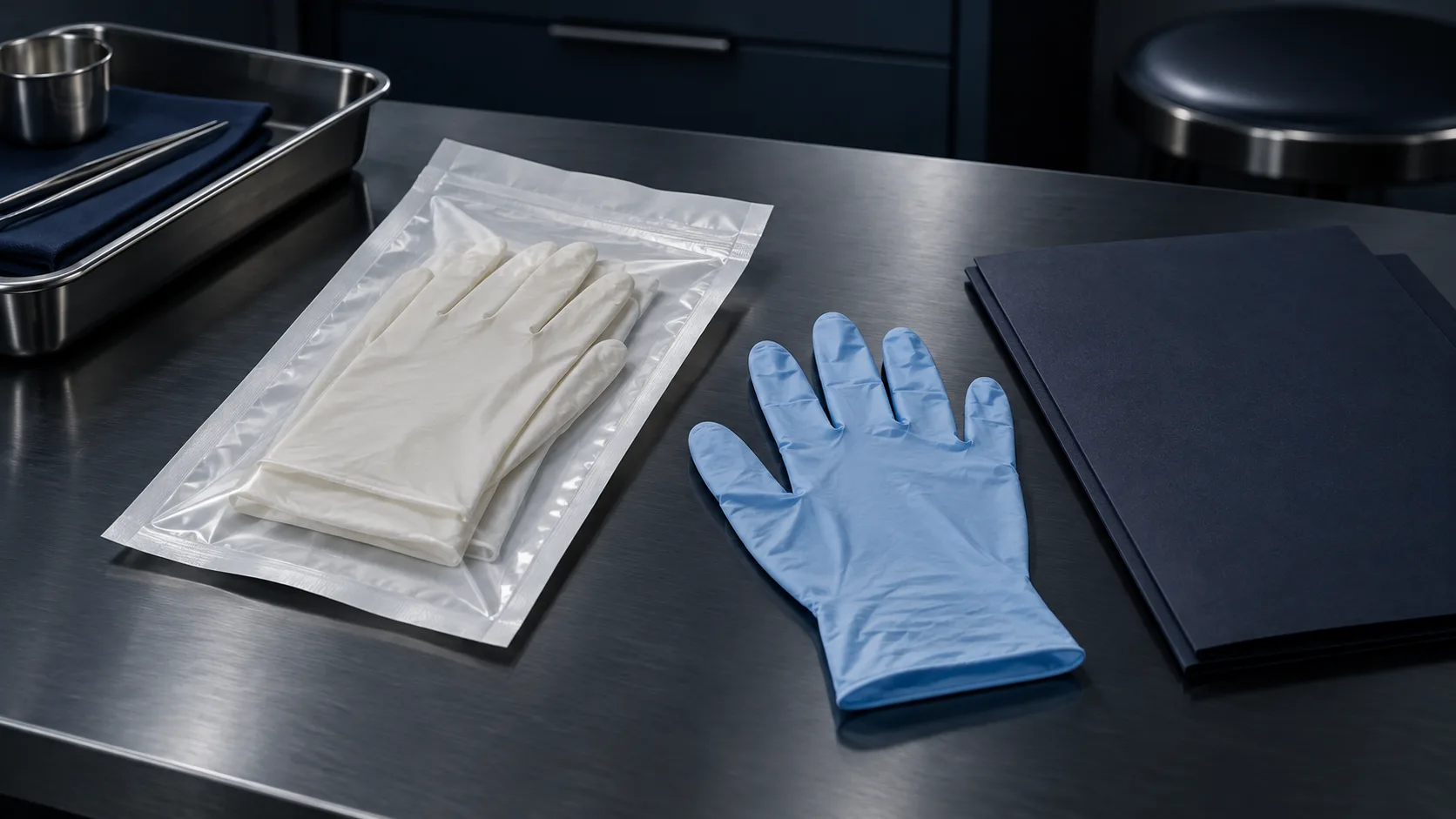
- Packaging: number of bag layers, sterile-barrier system where claimed, seal integrity, material compatibility and opening instructions.
- Traceability: lot link between glove, packaging, processing or sterilisation record, certificate and release decision.
- Shelf life: ageing evidence, storage conditions, remaining life requirement and integrity after transport.
- Other task claims: ESD, chemical protection or medical-device status supported separately for the exact product and destination.
Single, double and triple bagging are transfer controls
More bag layers are not automatically better. The pack configuration should support the actual airlock, pass-through or isolator transfer sequence without forcing an operator to carry an exposed outer surface into the next zone.
Ask where each layer is removed, which surface may be touched, whether labels remain readable through the transfer and how a damaged seal is handled. Confirm that the approved pack configuration is the one represented in product testing, shelf-life work and the order code. Do not infer sterility from a clear sealed bag or from the number of layers.
Verify a sterile claim against product and lot
For radiation sterilisation of medical devices, ISO 11137-1:2025 covers development, validation and routine control of the process. ISO 11137-2:2013, including its amendment and current revision status, addresses methods for establishing and auditing the sterilisation dose. These standards describe process controls, not a shortcut for accepting a supplier claim.
Match the certificate or release record to the exact product, lot, sterilisation method, processing site and packaging configuration. Check the certificate issuer, date, dose or process information appropriate to the record, disposition and any deviation. A generic facility certificate does not prove that a particular lot was released as sterile.
RFQ checklist by process
A useful request describes the controlled operation before naming a preferred glove. Send enough detail for the supplier to identify which fields need evidence and which remain open decisions.
- Industry, process step, destination market and applicable quality framework.
- Room class or GMP grade, with the terminology kept distinct.
- Sterile or non-sterile requirement and the reason for it.
- Particle, ionic, extractable, bioburden, endotoxin or ESD limits where applicable.
- Material, cuff length, hand-specific or ambidextrous format, sizes and garment overlap.
- Single, double or triple packaging and the planned transfer sequence.
- Chemical exposure and protection evidence assessed separately from contamination control.
- Required reports, certificate matching, lot-release records, shelf life and change-control notice.