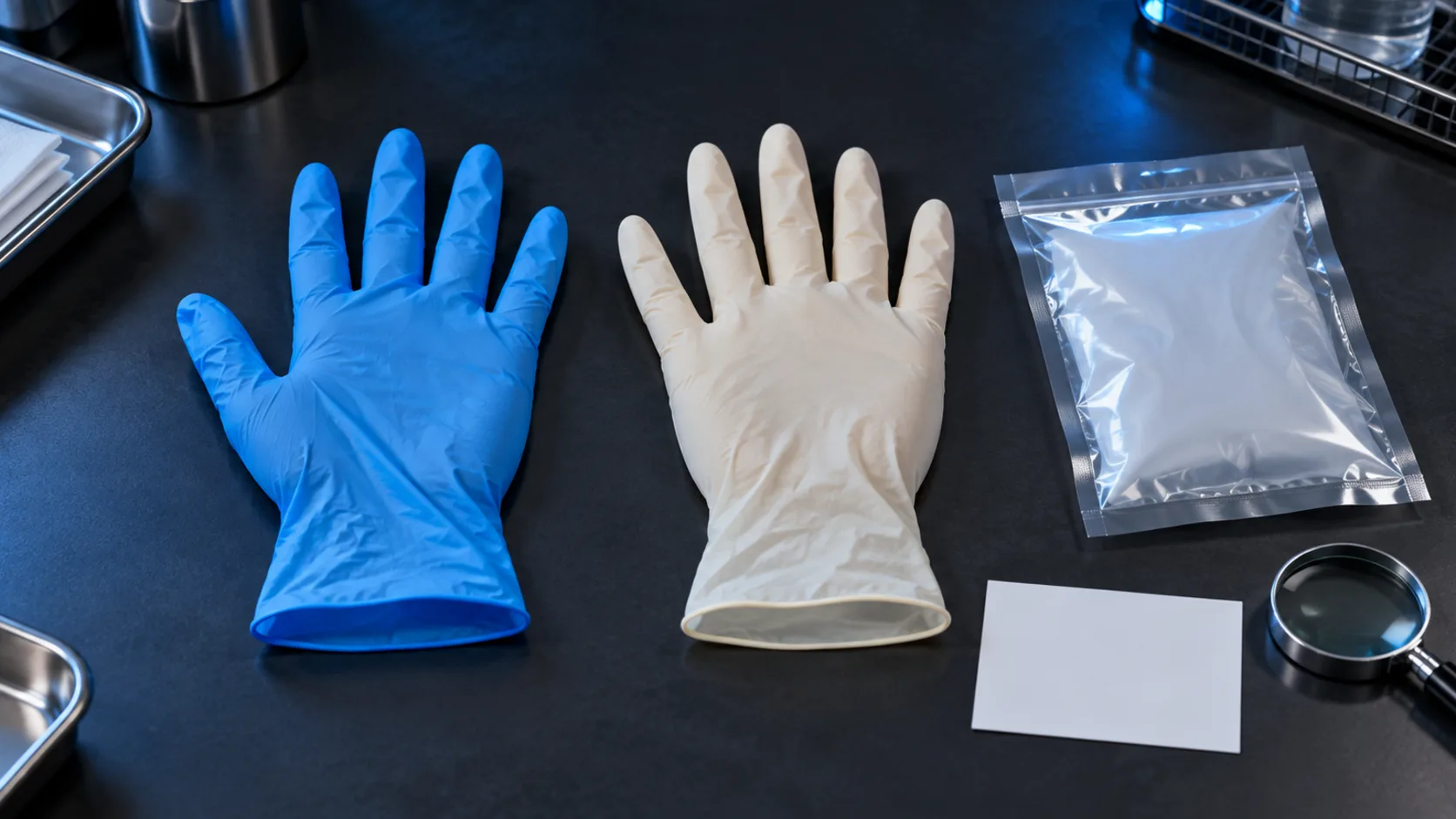
Disposable glove thickness: microns, mils and measurement points
How to compare glove thickness without confusing units, measurement locations, nominal values or performance claims that need separate evidence.
Published by NewGlove
Reviewed and updated 8 September 2026
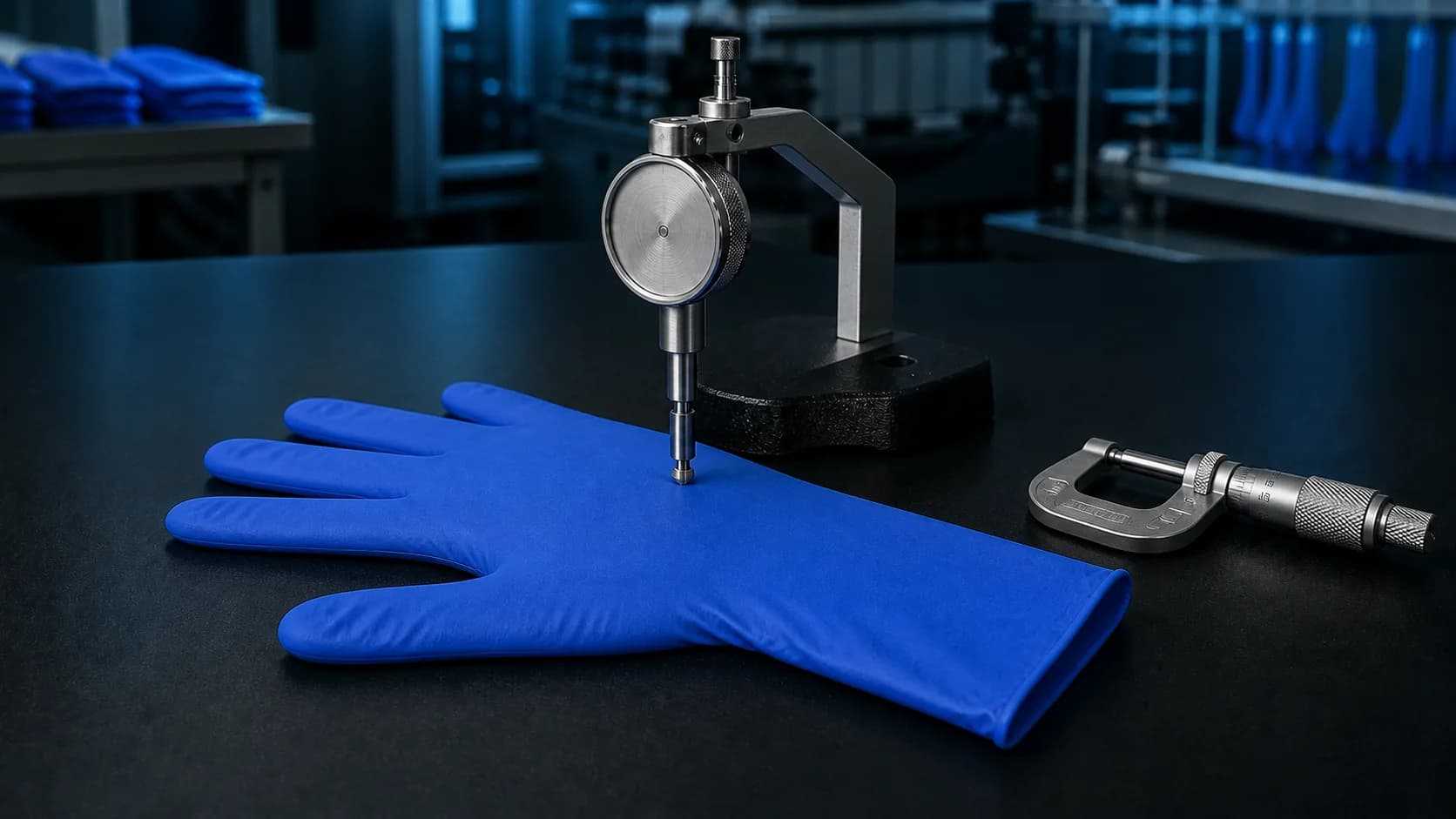
Disposable glove thickness is often reduced to one number in mils or millimetres. That number can be misleading when one supplier measures at the fingertip, another reports the palm, and a third publishes a nominal value without a tolerance or method.
Thickness affects the specification, but it does not prove chemical resistance, freedom from holes, tensile strength, durability, dexterity or suitability for a task. This guide helps buyers compare like with like. It is not safety, medical or regulatory advice; selection still depends on the workplace assessment and current evidence for the exact glove.
Convert the units before comparing
Millimetres and micrometres are metric units. A mil is one-thousandth of an inch, not one millimetre. Use the same unit across every candidate before ranking them.
- 1 millimetre equals 1,000 micrometres, often called microns.
- 1 mil equals 0.001 inch, 0.0254 millimetres or 25.4 micrometres.
- 2 mil is approximately 0.0508 mm; 3 mil is approximately 0.0762 mm; 4 mil is approximately 0.1016 mm.
- Treat conversions as a data-quality check. For example, 4 mil is about 0.102 mm, not 10 mm.
Finger, palm and cuff are not interchangeable
A disposable glove can have different thicknesses at the fingertip, palm and cuff because of its shape, manufacturing process and any texture. A single marketing number does not tell you where it was measured.
Ask whether the reported location is a finger, fingertip, palm or cuff; whether a textured area was avoided or included; whether the reading represents one layer; and how many gloves, sizes and production lots were sampled. Compare palm with palm and finger with finger.
- Fingertip or finger - often relevant to touch, texture and local material distribution.
- Palm - commonly used for specification and chemical-test specimens, but it does not describe every part of the glove.
- Cuff - can be thinner and has a different role from the palm or finger.
- Overall glove weight - a useful manufacturing control when defined by size, but not a substitute for thickness measurements at stated points.
Nominal, minimum, average and range mean different things
A credible specification labels the statistic. Nominal is a target, minimum is a lower acceptance boundary, average is a summary of the tested sample, and range or tolerance describes permitted variation. They cannot be compared as if they were the same promise.
A value also needs a sampling and measurement method. Gauge foot geometry, pressure, conditioning and specimen location can influence thin-film readings. Ask for the method and acceptance rule rather than assuming that extra decimal places mean better control.
- What statistic is published: target, nominal, minimum, mean or observed range?
- What tolerance applies, and is it one-sided or two-sided?
- Which sizes, colours, product references and lots were sampled?
- Which gauge or test method, specimen point and conditioning were used?
- Does the delivered-stock inspection use the same rule as the approved sample?
What medical-glove standards can and cannot tell you
ASTM D6319-19(2023) is an active specification for nitrile examination gloves used for medical applications and is recognised by the US FDA, with partial recognition. FDA 510(k) summaries applying D6319 commonly identify minimum palm and finger thicknesses and report the subject glove's measured values.
That US example shows why location and acceptance criteria matter. It does not create a universal minimum for every disposable glove, material, intended use or market. UK and European buyers should review the standards and regulatory route applicable to their product and destination rather than importing a US specification by analogy.
For single-use medical examination gloves made from rubber latex or rubber solution, ISO 11193-1:2020 provides a separate international specification and is currently under revision. EN 455-2 addresses physical properties for single-use medical gloves in Europe. In every case, request the exact report scope rather than relying on an unqualified standard number in a catalogue.
Why thicker does not automatically mean safer
More material may change feel, stiffness, tear behaviour and cost, but performance depends on formulation, manufacturing consistency, fit and the hazard. HSE notes that gloves vary by design, material and thickness, and that no glove protects against every substance or forever.
For chemical use, read permeation and degradation results for the exact substance and glove. For medical use, review freedom from holes, physical and biological evidence. For food handling, confirm the current food-contact evidence. Thickness cannot replace any of those checks.
- Chemical performance - substance, concentration, temperature, contact pattern, permeation and degradation data.
- Barrier quality - applicable freedom-from-holes method, sampling plan and lot controls.
- Mechanical behaviour - tensile, elongation, puncture or abrasion evidence where relevant to the intended task.
- Usability - fit by size, grip, dexterity, donning, fatigue and change triggers in a controlled task trial.
Build a thickness specification buyers can audit
A good purchase specification makes the comparison reproducible and keeps a factory sample from drifting into a different delivered product.
- Exact product reference, material, formulation revision, colour and size range.
- Finger, palm and cuff values in one unit, each labelled as nominal, minimum or permitted range.
- Measurement point, method, gauge conditions, sample size, sizes tested and lot definition.
- Glove weight by size as a separate control, with its own tolerance and method.
- Required regulatory status, intended use and destination market, assessed separately from thickness.
- Change-control rule requiring review before formulation, former, texture, thickness, weight, factory or packaging changes.
- Incoming-inspection rule and escalation process for results outside the approved tolerance.
Run a task trial after the evidence gates
Once candidates meet the required product and hazard evidence, trial the exact sizes and references in the real task. Record grip, dexterity, tearing, snagging, comfort, change frequency and user fit. Do not substitute another colour or weight without checking whether the evidence scope still matches.
Judge total task performance rather than thickness or unit price alone. A heavier glove can add material without solving the defined problem, while a lighter glove should not be approved where its evidence or trial performance is inadequate.