Are disposable gloves food safe? What UK and EU buyers should verify
Check the exact formulation, food types, contact conditions, migration evidence and market route before approving a disposable glove for food handling.
Published by NewGlove
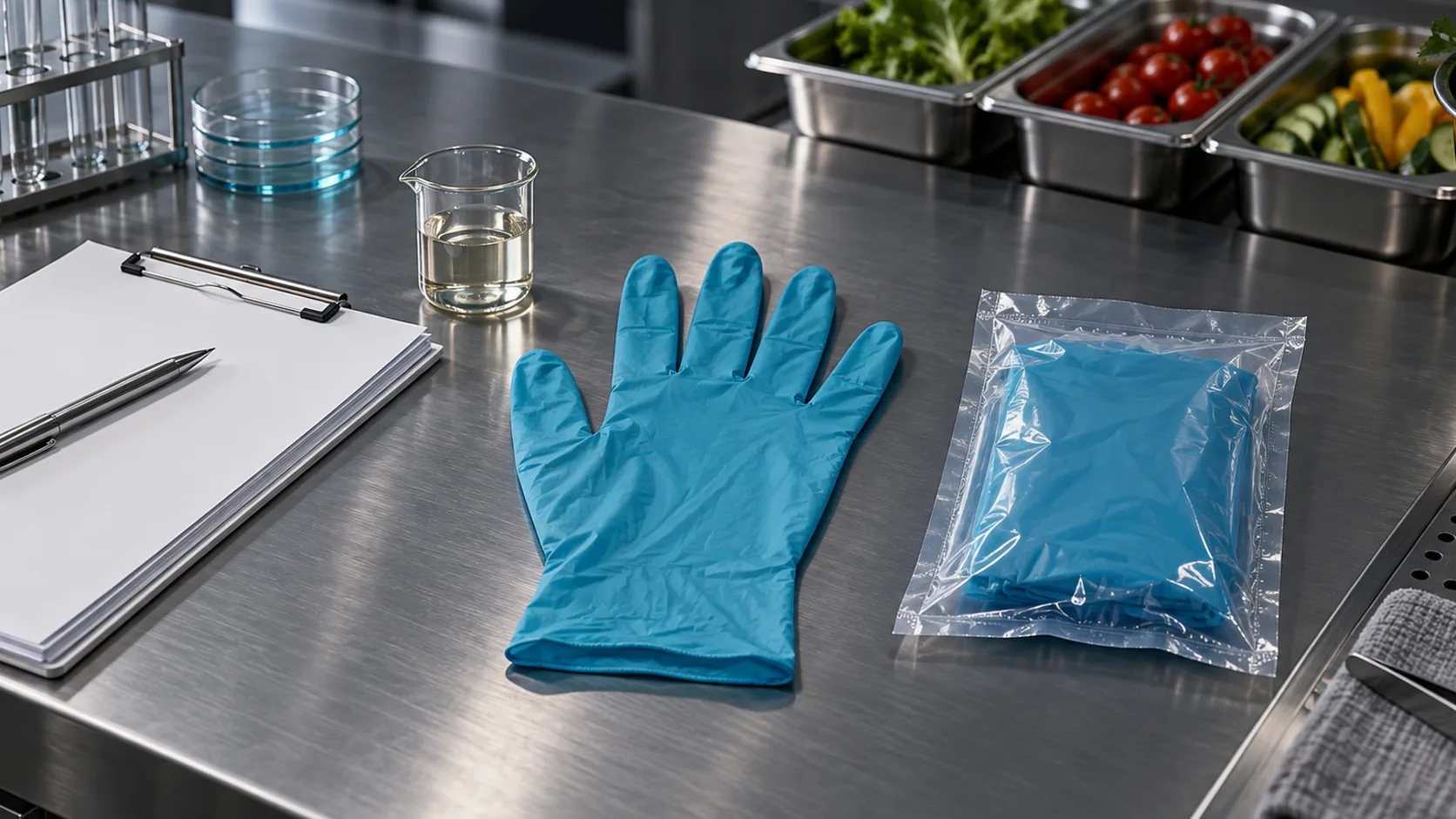
A disposable glove is not automatically food safe because it is nitrile, blue, powder-free or sold to a catering business. Approval should connect the exact product and formulation to the foods handled, contact time and temperature, repeated or single use, and the rules of the destination market.
This guide gives procurement and quality teams a practical evidence workflow for Great Britain, Northern Ireland and the European Union. It is general procurement information, not legal, food-safety or regulatory advice. Confirm the current law and obtain competent review for the exact glove and supply route.
Treat food safe as a defined use, not a box claim
The useful question is not simply whether a glove is food safe. Ask whether the named SKU is supported for direct contact with the actual food under the actual conditions at the named site. A glove used briefly with dry bakery goods presents a different contact profile from one used with fatty food, acidic ingredients, hot product or repeated wet handling.
Record the decision in a controlled specification. Vague wording such as suitable for food handling can hide the limits that matter most to the buyer.
- Exact glove reference, colour, size range and formulation or family scope.
- Food categories, including whether contact may involve fatty, aqueous, acidic, alcoholic or dry foods.
- Maximum contact time and temperature, including any hot-fill or chilled process.
- Single-use status, change points and whether the glove may contact more than one product stream.
- Destination market and the legal entity placing or importing the product there.
Separate Great Britain, Northern Ireland and EU routes
Food Standards Agency guidance explains that EU legislation applies in the EU and to Northern Ireland under the Windsor Framework, subject to the arrangements that apply to the movement. Great Britain covers England, Scotland and Wales and has a separate current position. A declaration prepared for one route should not be copied into another market file without checking its legal basis and scope.
The distinction is especially important after the EU's new BPA and other bisphenol rules. The FSA says the first key EU and Northern Ireland compliance deadline was 20 July 2026, while those EU restrictions do not currently apply directly in Great Britain. This does not prove that BPA is relevant to every glove. The formulation and materials must be assessed first.
Request an exact-product food-contact evidence pack
Ask the supplier to identify the legal framework and evidence that support the exact glove. Regulation (EC) No 1935/2004 provides the EU framework for materials and articles intended to contact food. Regulation (EU) No 10/2011 is specific to plastic materials and articles. Do not assume that every elastomer formulation falls into the same material-specific route.
A useful pack explains what was tested, how the tested sample maps to the supplied product, which foods or simulants and conditions were used, and what restrictions remain. A broad factory certificate or an unrelated test report cannot answer those questions.
- Current declaration or compliance statement for the exact product and destination market.
- Legal manufacturer, responsible supplier and economic-operator details where applicable.
- Material and formulation scope, including pigments, additives and processing aids where relevant.
- Migration or other test reports with sample identity, method, simulants, time, temperature and result date.
- Restrictions on food type, temperature, duration, repeated use or other conditions.
- Lot traceability and a process for notifying the buyer of a formulation or evidence change.
Match migration testing to real contact conditions
A passing result is only meaningful inside its test scope. Compare food simulants and test conditions with the site's worst reasonably foreseeable contact. If the glove may touch several food categories, the evidence should cover that range or the buyer should restrict its use.
Check whether the report identifies the finished glove or only a raw material. Confirm that the tested colour, thickness and formulation map to the supplied SKU. Changes to pigments, accelerators, surface treatments or other ingredients can require a new assessment rather than an assumption of equivalence.
Keep food-contact evidence and workplace protection separate
Food-contact suitability does not prove protection against cleaning chemicals, sharp tools, heat or mechanical hazards. Equally, PPE conformity or chemical permeation data does not prove suitability for direct food contact. Maintain separate approval fields for food hygiene and worker protection.
Where a worker handles disinfectants, degreasers or other chemicals, assess those substances and contact patterns against the exact glove. The correct product for cleaning may differ from the product used during food preparation.
Build change points into the hygiene procedure
HSE's current catering guidance says workers using gloves for food handling should wash their hands before and after wearing them, avoid cross-contamination and use single-use non-latex disposable gloves. Treat movement from raw to ready-to-eat food, or from an uncontrolled surface back to food, as a clear change point.
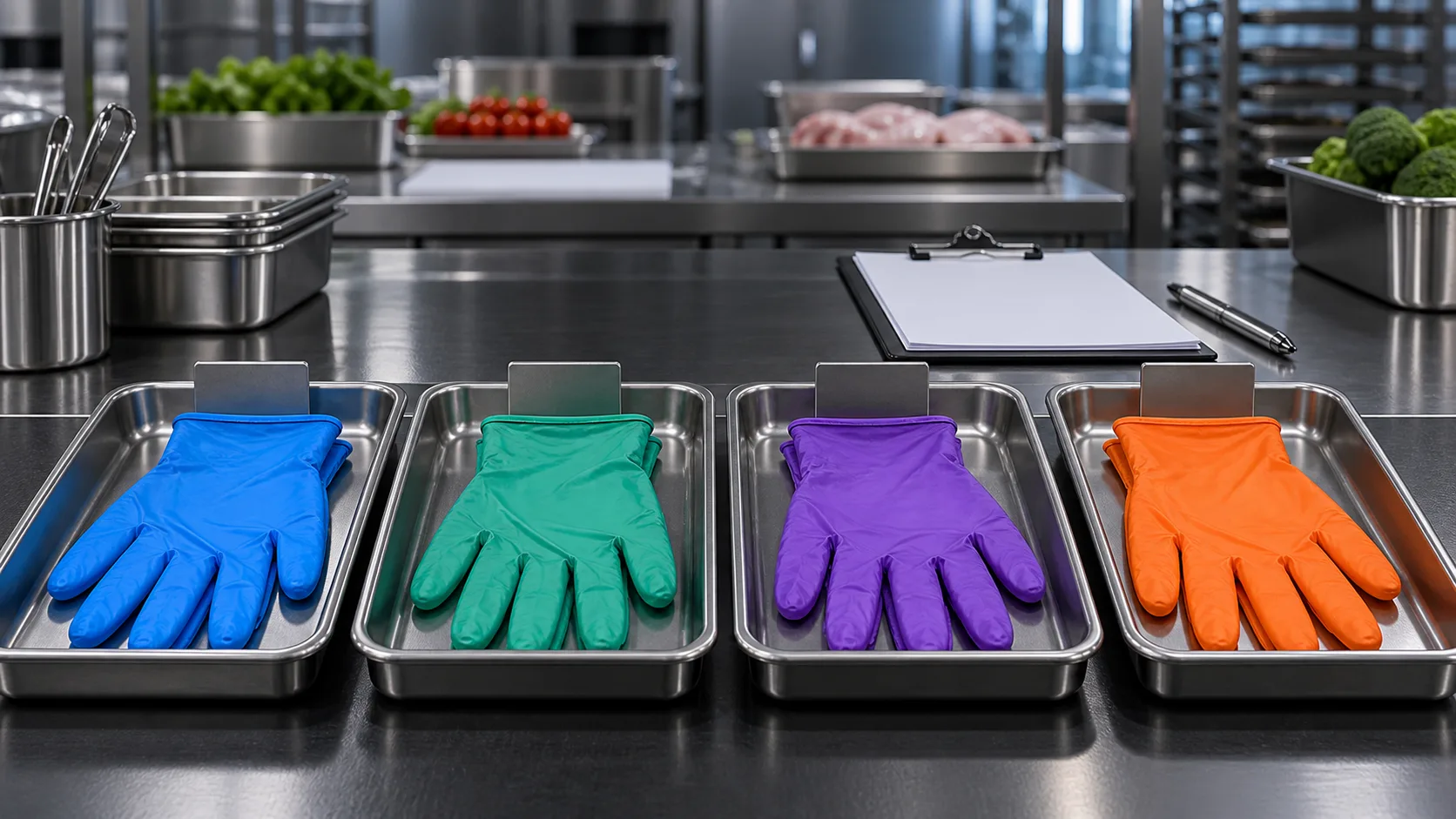
Write observable change points into the procedure. Colour coding can support a local system, but it does not replace hand hygiene, training, clean and dirty zoning or supervision.
- Wash and dry hands before donning and after removal.
- Use a fresh pair when moving from raw to ready-to-eat food.
- Change after waste, cleaning, cash handling, phones, doors or other uncontrolled surfaces.
- Change immediately after a tear, puncture, contamination event or loss of fit.
- Discard after removal and never wash or reuse a single-use glove.
Control receiving, storage and formulation changes
At goods-in, match the carton, inner pack, SKU, lot, expiry and supplier documents to the approved specification. Quarantine damaged, wet, untraceable or substituted stock until quality review is complete.
Require change notification for the formulation, pigment, manufacturing site, test method, legal manufacturer, packaging or destination-market declaration. A visually identical glove can have a different evidence position after an uncontrolled change.
Food-contact glove approval checklist
Use this shortlist before a trial or tender decision. It turns a generic food-safe request into a reviewable product file.
- Name the exact SKU, formulation, colour and sizes.
- State Great Britain, Northern Ireland, EU or other destination markets separately.
- List foods, contact times, temperatures and the worst foreseeable use.
- Map declarations and reports to the exact finished product.
- Check migration conditions, restrictions, dates and laboratory identity.
- Separate food-contact, PPE, chemical and medical-device claims.
- Define hand hygiene, task change points, training and disposal.
- Record lot traceability, storage and supplier change control.